If AI Is Cheating, Where Exactly Is the Line?
I remember when the internet came out. Yeah, that sounds strange. I know. But I do.
It was the early 90s.
The fear of the unknown got the best of a lot of people, and there were plenty of dissenters fueling the fire. Nobody really knew what the hell this thing was going to become. I certainly didn’t. I wasn’t even an early adopter of email. I would occasionally log on, but simply the experience of listening to those horrible sounds the computer used to make while connecting to God only knows where didn’t exactly make me want to spend more time there.
It’s kind of wild now to remember the split between those two worlds. Many of us were born before the internet and then watched the internet become the infrastructure for pretty much everything we do.
We’re still figuring out what it did and is doing to us.
Some people back then really did think we were going to die. We obviously didn’t. Instead, some people became millionaires and even billionaires because of it, businesses disappeared, entirely new ones were created, and life changed in ways I don’t think most of us standing there listening to a screaming dial-up modem could have possibly imagined.

We’re terrible at understanding transformative technology while we’re standing inside the transformation. Although, really, you could say that about almost any cultural shift. We like to believe we can see around corners. Most of the time, we can’t.
Which is why I’m not particularly interested in making predictions about whether AI is eventually going to save us, destroy us, take everyone’s jobs, or decide humans have had a good enough run.
Could it all go down? Sure. Give me a little heads-up so I can at least have some fun on the way out.
I’ve learned adaptability the hard way, and I’ve gotten pretty damn good at it. There are benefits to being nimble in an increasingly uncertain world. Maybe that makes me less afraid of another technological shift than some people.
What does bother me is the certainty surrounding it.
Because while everybody is busy deciding what AI means for humanity, I’m actually using it. Every day. As a research partner, a strategic sounding board, a creative tool, and a way to get my bearings in areas I don’t know enough about yet. I’m building a business without a pile of money or a team behind me, and AI has become one of the ways I bridge some of those gaps.
And I have to tell you the purity police are starting to annoy the shit out of me.
There’s plenty of outrage around AI, particularly in creative communities, and some of it is absolutely warranted. There are real questions about ownership, consent, compensation, and what happens to people’s work as these technologies evolve. We don’t know enough yet to pretend we know how all of this ends.
What bothers me is the absolutism.
I’ve seen plenty of it on Substack: the assumption that if you used AI anywhere in the creative process, you’ve cheated.
Cheated at what, exactly?
Substack recently introduced AI detection through Pangram. I usually turn mine off. Sometimes I forget. I recently published an essay and there it was: 100 percent human written.
Okay. It was. All of my essays are my writing.
But sometimes I dictate them.
I’ve spent my entire adult life using my hands professionally. Before writing, there were years of massage therapy and other hands-on work, not to mention more manual labor than I can count restoring and renovating houses. Then came nearly two decades of writing, which is a different kind of wear but wear nonetheless. So, much like my feet, my wrists and elbows now have opinions about how much work they’d like to do.
Sometimes I listen.
Dictating my thoughts into technology isn’t cheating. For me, it’s sometimes an accessibility tool.
Apparently, though, we have reached a point where we need technology to certify that a human wrote something. Which raises a much more interesting question: What exactly are we certifying?
The keystrokes? The thoughts? The sentences? The idea? The editing? The person who gets the byline?
Because writing has never been done in a vacuum.

I know this particularly well because I’m a ghostwriter.
I’ve written work for brands, executives, thought leaders, and other people who outwardly receive credit for words I wrote. That’s the job. I’ve worked on large campaigns, including work involving celebrities and technology, and helped create content that reached enormous audiences. In many instances, I’m contractually prohibited from saying I wrote it. Often, I can’t even use the work privately as a portfolio reference.
Nobody seems particularly scandalized by this arrangement.
Traditional publishing isn’t a solitary enterprise either. There are developmental editors, copy editors, researchers, agents, publicists, designers, illustrators, and, yes, ghostwriters.

Some editors do an extraordinary amount of work shaping a manuscript. Some people whose names appear on the front of books barely put pen to paper.
We’ve accepted all sorts of human assistance in creative work for a very long time.
So where, exactly, is the line?
If I use AI to catch a typo, have I cheated?
What if I use it to research something I don’t know how to do? Challenge an argument? Help me code something? Organize information? Create an image from an original concept? Animate characters I created?
What if I give it nothing of myself and ask it to write the whole damn thing?
Those aren’t the same thing. Yet we’re increasingly talking about them as if they are.
I’ve been building a children’s storytelling property called Where the Quiet Things Grow, and AI has allowed me to make things I simply would not have had the money to make otherwise.
I’ve bootstrapped the entire business. About a year ago, I made a conscious decision not to pursue additional clients. My life is covered, but that’s about it. This is the risk I’m taking. I’m working seven days a week, putting in the sweat equity, and, like most people building something from scratch, spending money before I’m making it.
There are things I won’t fuck around with. I’ve paid attorneys. I’ve paid for trademarks. I work with financial professionals and CPAs. If it’s outside my bailiwick or getting it wrong could really matter, I pay someone who is licensed and knows more than I do.
But I don’t have the resources to hire someone for every single thing I don’t know how to do. So the rest of it? I’m pretty resourceful. I know how to create things out of nothing. I figure it out.
AI is one of the tools helping me do it.

Without it, The Ants & The Peony could have existed as words. What I could not have afforded was the visual world around those words.
Anyone who thinks creating that world means typing a sentence into a box and pressing a button should have spent last weekend with me.
I probably spent eight hours on the cover alone.
Forty or fifty iterations, easily.
An image takes time to generate, and when you’re creating a picture book, pretty isn’t enough. Characters have to remain consistent. Scale has to make sense. The visual language has to carry from one spread to another. Continuity matters. Composition matters. Emotional expression matters. An image can be beautiful and still be completely wrong.
I’m a writer, but I’ve also spent years working as a creative director. Creating these books has required me to think like a director in ways I never had before. Animation has required me to learn things I didn’t know.
AI hasn’t eliminated the work. It has made different work possible.
Give the same generative AI program to someone who has never written, art-directed, or worked in visual storytelling and give it to someone who has spent decades doing those things, and I don’t believe you’re going to get the same result.
A tool is only as good as the person using it.
I think about AI a little like I think about what we used to call alternative medicine. Somewhere along the way, much of that conversation became less about choosing sides and more about choosing the appropriate tool. Conventional medicine when that’s what the situation calls for. Something complementary when it isn’t. Often, both.
I learned the same lesson renovating houses. You don’t become blindly loyal to a hammer. You use the tool most appropriate for the job.
I think we’re making a mistake when we demand that people declare themselves either for AI or against it. I’m neither. It’s a tool. Sometimes it’s the right one. Sometimes it isn’t. The judgment is in knowing the difference.
Which is where the economics of this conversation start to bother me.
Capital has always bought creative capacity.
meggen harris
A well-funded creator can hire an illustrator, animator, editor, researcher, designer, developer, production team, publicist, and social media staff. Nobody looks at the finished product and says, “Well, you didn’t really make that. You had help.”
Assistance becomes evidence of professionalism when you can afford enough humans to provide it.
But when someone without those resources uses technology to access some of that same capacity, suddenly we’re having a conversation about authenticity.
Why?
Then, there is Hollywood. Actors and writers have legitimate concerns about AI, particularly when it comes to jobs, compensation, consent, training data, and the unauthorized use of someone’s voice or likeness. Those concerns shouldn’t be dismissed. In fact, the unions themselves have negotiated considerably more nuanced positions than some of the sweeping anti-AI rhetoric would suggest. SAG-AFTRA’s framework centers on consent, compensation, and control, while the Writers Guild of America allows writers to choose to use AI on covered work with company consent while prohibiting companies from requiring them to use it.
Meanwhile, in March, Netflix quietly acquired InterPositive, the AI filmmaking technology company founded by Ben Affleck, one of the industry’s most recognizable actors and directors and most certainly a card-carrying SAG-AFTRA member. Netflix described the technology as being built by and for filmmakers, with filmmakers remaining at the center of the creative process.
Affleck isn’t the villain in this story. Not by any stretch. If anything, he’s evidence of how much more complicated the story actually is.
AI technology developed by an established filmmaker and acquired by one of the world’s largest entertainment companies is innovation.
AI used by an independent creator trying to build something without institutional backing can still be treated as cheating.
Who decided that?
And when does an efficiency become legitimate? When a studio owns it? When a union negotiates protections around it? When a famous filmmaker develops it? When a corporation spends hundreds of millions of dollars acquiring it?
Or can it also be legitimate when somebody sitting at home pays for a subscription, learns the technology, and uses it to make something they otherwise couldn’t afford to make?
None of this means I think anything goes.
My line is theft.
And by theft, I mean taking someone else’s creative identity, intellectual property, likeness, voice, or original work without permission and using it for your own benefit—or trying to pass it off as your own.
I’ve been plagiarized. I’ve had another journalist take a published article of mine nearly verbatim. I remember calling the person’s editor and listening while he compared my work with theirs. His reaction was essentially the same as mine: Oh my God.
Yes. That’s plagiarism.
But I’ve had other versions of it happen too, particularly with my Forbes work. Imagine scrolling through Instagram and suddenly seeing your own face and your own words staring back at you in an ad for a company you’ve written about. Not an editorial post. Paid advertising. I’ve had brands take my likeness and my work and use them commercially without asking my permission, compensating me, or even bothering to tag me or link back to the article that put me there.
In probably the most egregious example I’ve experienced, one company went beyond my face and my words and took pieces of my personal story to use in its advertising as though my story belonged to them.
That’s not some theoretical conversation about what AI might do to creators someday. People have been taking things that don’t belong to them and monetizing them for a very long time. Depending on the circumstances, using someone’s likeness commercially without permission isn’t merely shitty behavior; it can create actual legal liability.
So no, imitation fucking ain’t flattery to me.

That’s why my line with AI isn’t whether someone got assistance from a machine.
It’s whether they used that machine to take something that wasn’t theirs.
AI didn’t invent plagiarism. It made plagiarism potentially faster, easier, and more scalable.
Stealing someone’s likeness, cloning someone’s voice without permission, taking somebody else’s intellectual property, or feeding someone’s work into a machine because you want something just like theirs raises very different questions than using technology to execute your own original ideas.
That’s the distinction I care about. It’s also why I disclose my use of AI.
Someone recently asked me what AI I use, perhaps expecting some secret piece of sophisticated software.
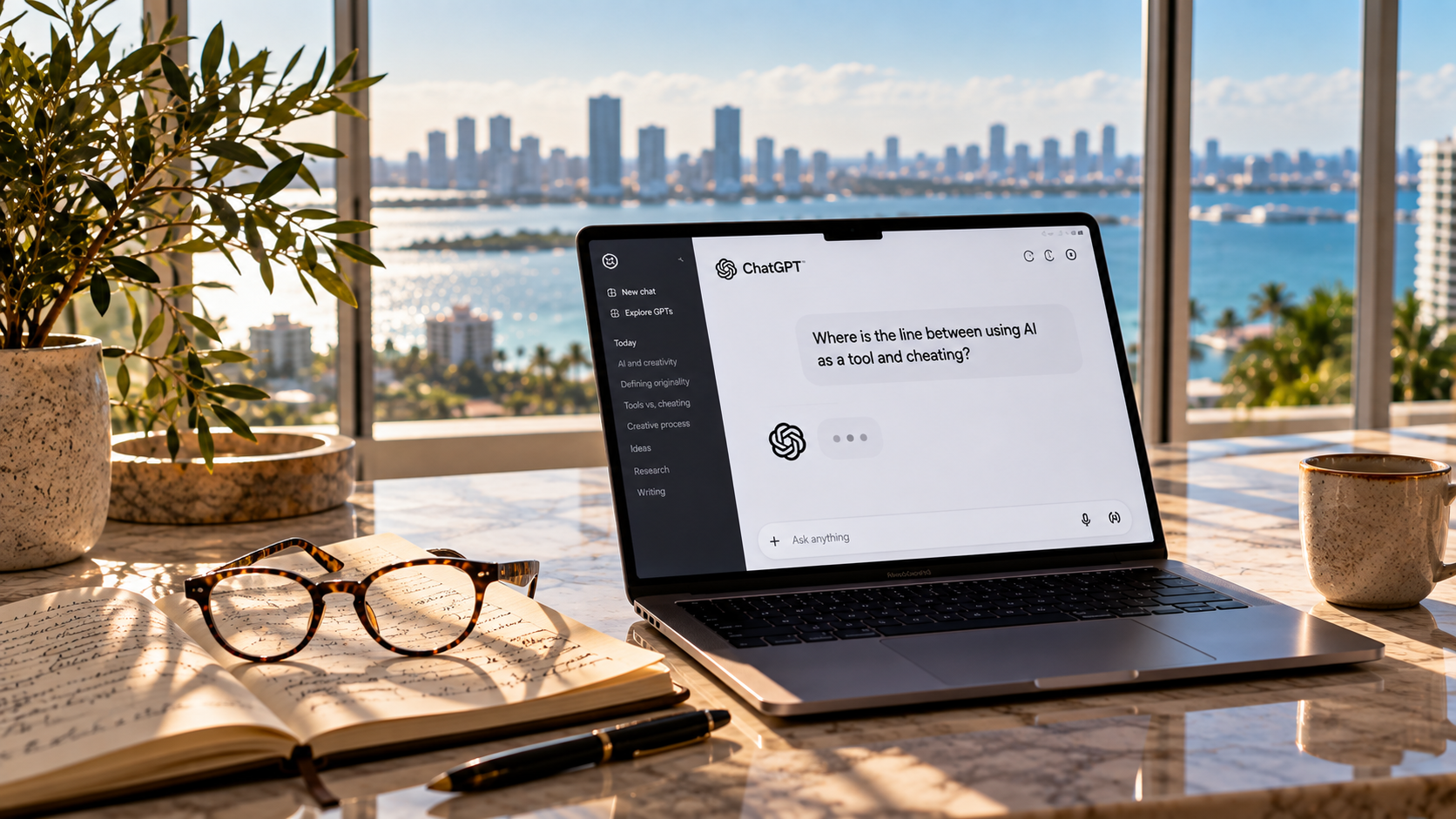
ChatGPT. That’s it.
I’m sitting down with a commercially available tool and figuring shit out. I’m practicing. I’m learning what works and what doesn’t. I’m getting better at using it.
I have nothing to hide.
In fact, the assumption that disclosure should feel like a confession is part of what bothers me about this conversation in the first place.
My position may change. None of these opinions are carved in stone. The technology is changing too quickly, and so are the consequences. If these tools increasingly become vehicles for stealing people’s work, eliminating ownership, or stripping creators of control over their own intellectual property, I’ll reevaluate.
I’m using AI for the good I can do with it now.
I don’t know where this technology goes. None of us do. And I’m not pretending otherwise. Ten years from now, some of what we believe about AI today may look ridiculous. Some of the things we’re afraid of may turn out to have been nowhere near fearful enough.
We’re standing inside the transformation. Of course we can’t see all of it yet.
But I do know this: democratizing access to creative tools doesn’t democratize ownership of somebody else’s creativity.
The question isn’t whether a creator used AI.
The question is whether a creator was there at all, whether the ideas were actually theirs, and whether they used the technology to expand what they could create or to take what someone else already had.
Tools change.
Authorship still matters.
△ △ △