


7 Of The Most Profitable Platforms For Creators In 2026 And How They Pay
Not all platforms are created equal—especially when it comes to how creators make money.
Some are designed to maximize reach, while others are built to convert attention into income—and increasingly, that distinction is shaping who succeeds within the creator economy.
The Creator Economy Myth: Why Views Don’t Equal Income
The creator economy has matured into a multi-billion-dollar industry—but how creators actually make money is still widely misunderstood.
For years, success has been framed as a function of visibility: the more views, followers, or engagement you generate, the more money you make. But that assumption is breaking down.
Today, some creators with millions of followers struggle to monetize, while others with far smaller audiences are quietly generating six—and even seven—figure incomes. A creator with millions of followers on TikTok may rely heavily on inconsistent brand deals, while a niche writer on Substack with a few thousand paid subscribers can generate predictable, recurring revenue.
Creator income is far less about reach than it is about structure—and nowhere is that more evident than in the platforms themselves. Because not all platforms are designed to pay creators equally.
Some are built for distribution. Others are built for monetization. And understanding the difference is often what separates creators who earn from those who don’t.
What Makes A Platform Profitable For Creators?

The platforms generating the most meaningful income for creators today share a common trait: they enable direct monetization, ownership, or high-leverage distribution.
This list is based on a combination of creator earnings reports, industry data, platform payout structures, and observed monetization patterns across top-performing creators—not just audience size, but actual income generation.
Industry reports consistently show that creator income is driven less by audience size and more by monetization model—particularly access to subscriptions, products, and owned revenue streams.
Here’s how they compare.
YouTube: The Most Scalable Creator Revenue Platform
YouTube remains one of the most robust income platforms for creators, largely due to its diversified monetization model.
Revenue can come from ad sharing, brand partnerships, long-form content, and increasingly, integrated product ecosystems.
Creators like MrBeast have turned the YouTube platform into full-scale businesses, with estimated annual earnings reaching around $80–85 million.
His income is driven not just by views, but by an ecosystem of products, partnerships, and owned ventures layered on top of his content.
For most creators, ad revenue alone is rarely enough. The real upside comes from what sits behind the content.
Substack: Turning Audience Into Recurring Revenue
Substack represents a different model—one built around ownership and recurring income.
Instead of relying on algorithms, creators monetize directly through paid subscriptions, building predictable revenue streams from smaller but more engaged audiences.
Some top writers now generate hundreds of thousands—or more—annually through subscription-based models alone. This approach prioritizes depth over scale, making it one of the most sustainable platforms for creators focused on long-term income.
Patreon: Building Membership-Based Income
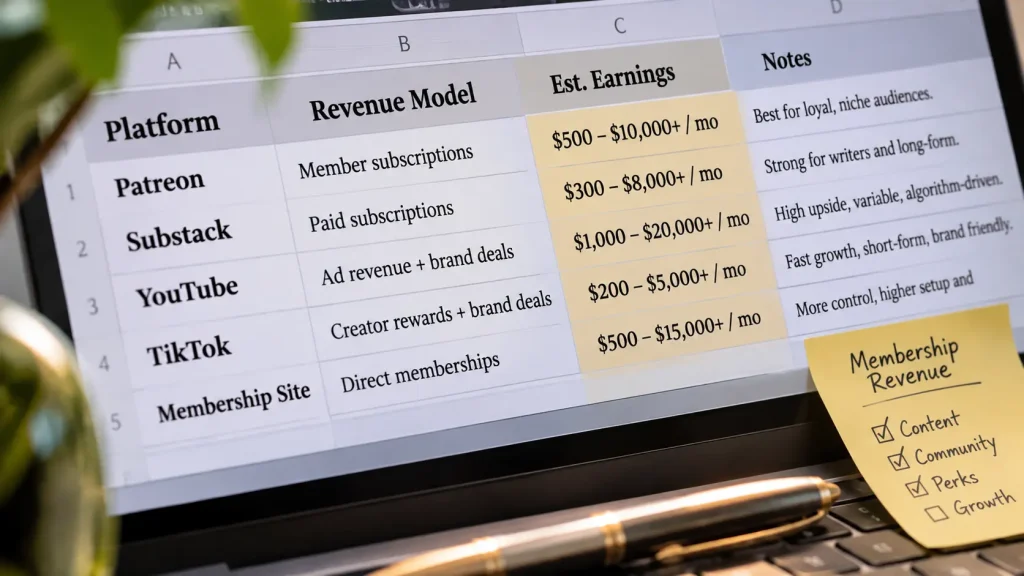
Patreon operates similarly to Substack but across a broader range of creator types, from podcasters to educators and artists.
It allows creators to build membership-based communities, offering exclusive content or access in exchange for recurring payments. While growth can be slower, the model creates stable, predictable income—particularly for creators with highly engaged niche audiences.
OnlyFans: High-Earning Direct-To-Audience Monetization
Often overlooked in mainstream business conversations, OnlyFans is one of the highest-paying creator platforms globally.

Its model is simple: direct-to-audience subscription income.
Creators retain roughly 80% of the revenue they generate through subscriptions, tips, and pay-per-view content. What it demonstrates clearly is that monetizing access—not just attention—can be one of the most effective income strategies in the creator economy.
Gumroad: Monetizing Digital Products At Scale
Gumroad reflects a growing shift toward product-based monetization.
Rather than relying on content itself for income, creators use platforms like Gumroad to sell digital products—courses, templates, guides, or software.
This model allows income to scale beyond time or output, turning content into a distribution layer rather than the product itself.
TikTok: High Reach, Low Direct Monetization
TikTok excels at reach—but not necessarily at direct monetization.
Many creators have built massive audiences on the platform, translating visibility into significant brand partnerships, with top-tier influencers often commanding six-figure payouts for individual sponsored posts.
However, platform-native monetization tells a different story.
Even with newer monetization programs, TikTok’s direct payouts remain relatively low. Creators typically earn between $0.40 and $1.00 per 1,000 views, meaning even viral content generates modest income compared to brand deals or owned revenue streams.
As a result, TikTok is best understood as a top-of-funnel platform—exceptionally powerful for discovery but limited as a standalone income engine.
Instagram: Strong For Brand Deals, Not Platform Pay
Instagram operates similarly, with revenue driven primarily through brand partnerships rather than platform payouts.
Creators with strong personal brands can generate substantial income, with top influencers commanding anywhere from tens of thousands to well over six figures per sponsored post.
At the same time, many mid-tier creators earn far less—highlighting how inconsistent and relationship-dependent this model can be.
Where Creator Income Is Actually Coming From
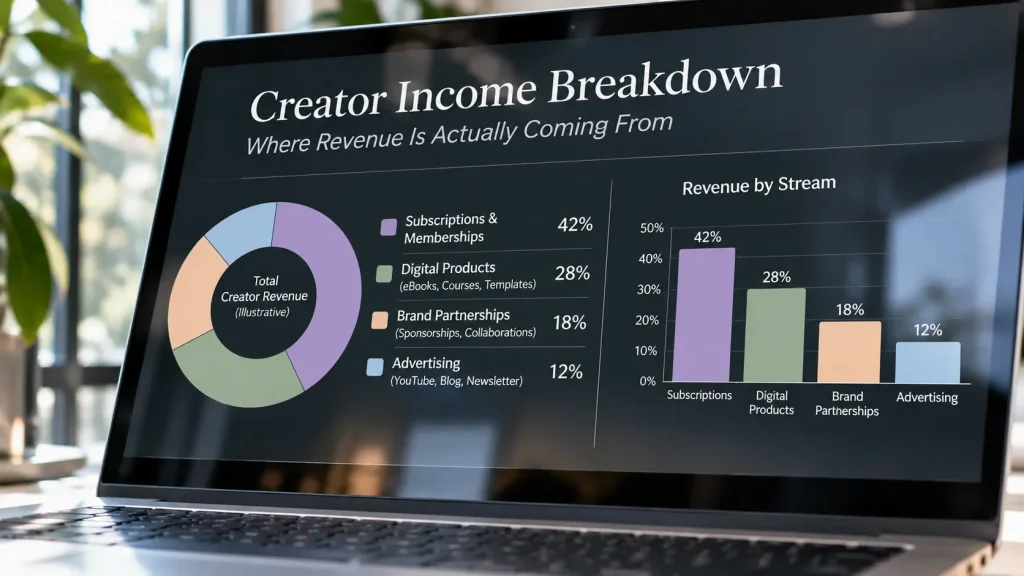
Across platforms, a clear pattern emerges: the most reliable income comes from models that creator’s control.
Multiple creator economy reports have noted that the highest-earning creators generate the majority of their income from owned channels and direct monetization—not platform payouts alone.
In many cases, creators are increasingly combining content with more stable, location-independent income streams—including high-paying remote roles that support a digital nomad lifestyle.
Ad revenue—whether from YouTube or platform funds—is often the least predictable income stream.
By contrast, the most stable and scalable income tends to come from subscriptions, digital products, services, and brand partnerships built on top of owned audiences.
Why The Highest-Traffic Platforms Don’t Always Pay The Most
One of the most persistent misconceptions within the creator economy is that visibility equals income.
Platforms like TikTok and Instagram can generate massive reach—but that reach does not always translate into revenue.
Without a clear monetization layer, creators can accumulate large audiences while earning relatively little from the platform itself.
In many cases, these platforms function best as discovery engines—driving awareness that must then be converted elsewhere.
How Top Creators Build Multi-Platform Income Streams

The most successful creators are no longer relying on a single platform. Instead, they are building ecosystems.
A typical model might include:
TikTok or Instagram for discovery
YouTube for deeper engagement
Substack or Patreon for monetization
Content drives attention, attention builds trust, and trust is ultimately what converts into revenue.
What This Means For Creators In 2026
The opportunity within the creator economy remains significant—but it is increasingly structured. Success is no longer defined by where you post, but by how you build around it.
Creators who understand how platforms function are far more likely to succeed than those who rely on visibility alone. Because in today’s creator economy, platforms don’t pay equally—and the creators who understand the system are the ones who learn how to build around it.
△ △ △
Author’s Note | October 2026
Since originally publishing this article in Forbes, I’ve been thinking more about the difference between creating something people see and building something that can actually sustain you.
As a journalist, author, and founder of an independent creative studio, I find myself navigating both sides of that equation. One of the things I’ve come to appreciate is that creating something and promoting it are not simply two parts of the same job. They are two entirely different jobs, each requiring their own skills, time, energy, and expertise.
There’s the work itself: writing the article, developing the story, producing the animation, creating the book. Then there’s the work of getting that creation into the world, finding an audience, building relationships, managing distribution, and figuring out how any of it might eventually generate income.
That second job is enormous.
Every platform has its own ecosystem. What works on YouTube doesn’t necessarily work on Instagram. TikTok has its own language, formats, algorithms, and expectations. Substack operates differently again. Even when the underlying creative work is the same, presenting it effectively across these channels often means producing entirely different versions of it.
The idea that independent creators can simply make something wonderful, post it everywhere, and watch an audience materialize is appealing. It’s also wildly disconnected from the amount of labor involved.
Resources change the equation considerably. Someone with substantial financial backing can hire people to handle marketing, editing, distribution, production, and audience development. They can build a team, delegate responsibilities, and devote more of their own attention to the creative work.
For a one-person operation or a tiny team working with limited resources, the situation looks very different.
You’re not just the creator. You’re the publisher, marketer, publicist, strategist, distributor, and often the person troubleshooting whatever technical problem has consumed the better part of your afternoon. Meanwhile, you’re somehow supposed to keep creating the next thing.
I’ve written about this frustration in my essay, I Don’t Hate the Game. I Hate What the Game Requires. It’s not that I object to the work involved in building an audience or a business. I understand why those things matter. What I question is the expectation that an individual creator should be able to perform all these roles simultaneously, consistently, and successfully.
There’s also a financial paradox here. You often need revenue to hire the people who can help you generate revenue. Until you reach that point, you’re responsible for everything, and the hours spent marketing yesterday’s work are hours you cannot spend creating tomorrow’s work.
I’m speaking from the perspective of someone currently operating with very lean resources. My professional circumstances are uncertain, and I’m in the early stages of building a new business—one that, like most new ventures, requires substantial investment of time and effort before there’s any assurance of profitability.
I don’t have a large team or a substantial marketing budget. Much of what I’m doing involves learning as I go, stretching the resources I have, and making decisions about where my limited time and money will have the greatest impact. Some days, that feels manageable. Other days, the sheer number of things requiring my attention is overwhelming.
None of this diminishes the opportunities that today’s platforms provide. Independent creators have access to distribution channels that would have been unimaginable a generation ago. That matters, and I’m grateful for it.
But access to a platform isn’t the same as having the resources to succeed on it.
I occasionally wonder whether I’m being wildly unrealistic about what I’m trying to build. Perhaps I am. I also know that I believe in the work itself, even when I can’t see exactly how the business will take shape or when it might begin to support me financially.
For now, I’m doing the best I can with what I have, trying to make thoughtful decisions, and holding on to the belief that creating something worthwhile is still worth the effort.
Perhaps that’s another part of the creator economy we don’t discuss enough: the enormous amount of faith required to keep making something before you have any evidence that the world will make room for it.