
The Copycat Economy: What Are We Actually Rewarding?
Within the span of 24 hours, two people I know and respect independently introduced me to someone I’d never heard of: Devon Canup, an entrepreneur behind Low-key Rich, whose online presence revolves around making money on the internet.
The first was someone I’d connected with through Substack. She sent me two of his recent posts, in which he talked about how much money he was making, which I found a bit braggadocious. Or perhaps low-key obnoxious, to borrow his vernacular.
I listened while walking to the grocery store.
I wasn’t particularly impressed. People have been selling the promise of getting rich for as long as there’s been money to make.

The following day, a friend I’ve known for more than 20 years brought him up again.
What were the odds?
Two people whose opinions I value, neither connected to the other, had introduced me to the same man within a single day.
So I paid closer attention.
He talked about KPIs, data points, identifying what performs, and understanding how content spreads. Fair enough. There’s nothing revolutionary about studying analytics or figuring out how to reach an audience. Entire libraries have been written about marketing, virality, and distribution.
Then I heard a word that made my blood boil.
Copy.
Not study. Not learn from. Not take inspiration from.
Copy.
Now, I understand copying a successful business model.
They’re called models for a reason. They’re meant to be studied, adapted, and replicated.
But people aren’t models. Unless, of course, you’re a model model.
We’re individuals, with our own experiences, perspectives, talents, and ideas. So when someone talks about copying what works, I find myself wondering where the model ends and the individual begins.
Just like that, he’d lost me.
I’ve spent much of my professional life writing, creating, and developing original ideas. I’ve also had my work plagiarized, my personal experiences appropriated, and my likeness used without permission.
I take the distinction between inspiration and imitation seriously.

Recently, I wrote an essay titled If AI Is Cheating, Where Exactly Is the Line?, exploring the increasingly blurry boundaries between technology, authorship, and creative ownership.
My personal line was straightforward: plagiarism.
AI didn’t invent plagiarism. It made copying someone else’s work potentially faster, easier, and infinitely more scalable.
Yet there I was, walking to Trader Joe’s, listening to someone discuss online success in terms that, to my ears, made copying sound like part of the strategy.
I don’t know enough about Canup or his business to offer a comprehensive judgment of either. Nor do I intend to. He’s one of countless people teaching others how to build audiences and monetize content. Some of that advice may be useful.
He isn’t the villain of this story. In fact, he’s barely the subject.
He simply touched a nerve.
For months, I’ve been thinking and writing about the uneasy relationship between creativity, technology, attention, and financial success. His comments brought those questions into sharper focus.
What happens when originality becomes optional? When someone else’s creative labor becomes the starting point for another person’s revenue stream? When being exceptionally good at packaging and distributing an idea becomes more commercially valuable than developing the idea in the first place?
Increasingly, I’m wondering what we’re actually rewarding.
Being Good at the Thing Versus Being Good at the Game
The thing is whatever you actually do.
Writing. Filmmaking. Painting. Designing. Building a business. Developing an idea, refining it, getting it wrong, starting over, and eventually producing something that belongs to you.
The game is getting people to notice.
Marketing. Distribution. Algorithms. Engagement. Analytics. Conversion.
Both require skill. They’re simply not the same skill.
I’ve spent enough years working in communications to understand that attracting attention, particularly sustained attention, is no small achievement.
I’ve also written about my complicated relationship with the demands of distribution in I Don’t Hate the Game. I Hate What the Game Requires.
I understand the game. I’m capable of playing it. What I don’t have is an unlimited supply of time or resources.
I’m writing books, developing visual storytelling, maintaining a website, continuing my journalism, and assembling an archive of work that stretches back years. Even with AI, creating a single piece of promotional content can take hours because the details matter to me.
Meanwhile, every platform has its own demands, formats, audiences, and measures of success. Growth is rarely linear. Subscribers come and go. Engagement rises and falls.
I know how to do this work. The difficulty is finding the time to do it to my standards while continuing to create the work I’m supposed to be promoting.
It’s hard for people to find my work because I’m too busy making it.
That’s a frustrating predicament, but it isn’t the central question here. I’ve already explored that elsewhere.
What interests me now is something different.
What happens when someone becomes exceptionally good at the game without necessarily having to make the thing?
When Attention Becomes the Product

Look around Substack.
A platform ostensibly devoted to writing has become crowded with people dispensing advice on how to succeed on Substack.
Notes about gaining subscribers. Notes about increasing engagement. Notes about writing better Notes so more people will read your Notes.
It’s an entire ecosystem of people teaching other people how to attract people.
I’m left wondering what, exactly, everyone is supposed to be attracting them to.
The same dynamic exists across Instagram, YouTube, and practically every other platform. An entire industry has emerged around teaching people how to capture attention, grow an audience, and turn that audience into revenue.
There’s nothing inherently wrong with that.
Marketing has always been a profession. Distribution creates value. Connecting people with products, ideas, entertainment, and information they might otherwise never discover is a legitimate skill.
The distinction becomes less clear when attention itself is the product.
You don’t necessarily need to write a remarkable book, develop a groundbreaking product, or master a particular craft. You need to attract enough people, keep them interested, and figure out how to monetize that attention.
The pitch is seductive, particularly at a time when so many people are struggling to imagine a financially secure future.
Why spend years learning a craft, building a business, or developing expertise when someone promises to show you how to generate income by following a proven formula?
I understand the appeal.
Who wouldn’t want financial freedom? Who wouldn’t want to spend less time working and more time living?
At 51, I certainly would.
But there’s something peculiar about an economy in which the promise of escaping work has become a product people sell to one another.
Where does the value actually come from?
If someone creates a useful product, provides a valuable service, or helps an audience discover something worthwhile, there’s an identifiable contribution.
But what happens when the business model depends primarily on identifying what someone else has already made successful, reproducing its appeal, and capturing a portion of the resulting audience?
The original creator may effectively become an unpaid research-and-development department for someone else’s business.
That isn’t necessarily illegal. It isn’t always plagiarism.
It may even be perfectly ordinary competition.
Which is where things become more complicated.
The Copycat Economy Is Nothing New
Fashion offers an interesting example.
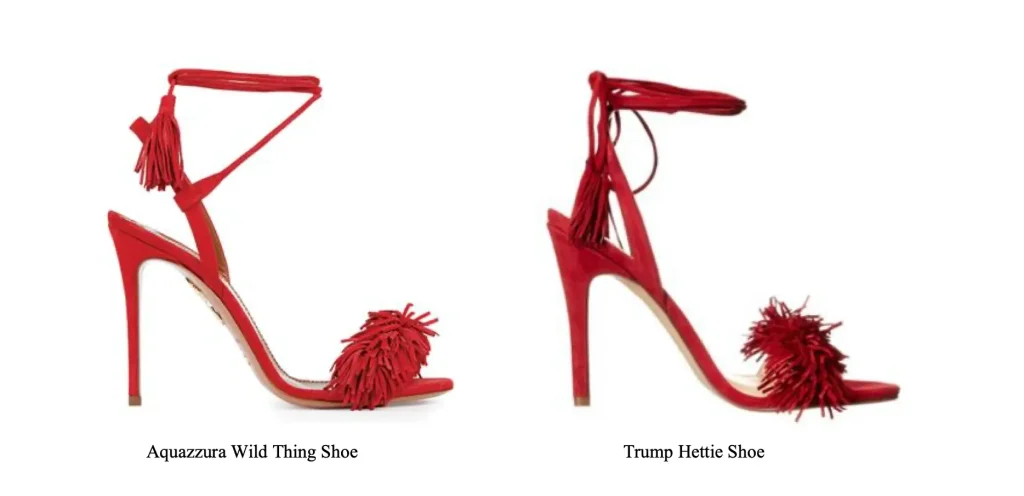
Years ago, I interviewed Ivanka Trump when she was building her fashion brand. In 2016, luxury footwear designer Aquazzura sued over allegations that a sandal sold under Trump’s brand copied its distinctive Wild Thing design. The parties dismissed their claims in 2017, without a reported judicial determination of infringement.
The dispute reflected a much larger conversation that has followed the fashion industry for decades.
Luxury designers create something distinctive. Less expensive brands produce similar styles. Consumers who cannot or do not want to spend hundreds or thousands of dollars on a particular item gain access to a comparable aesthetic at a more affordable price.
From a consumer’s perspective, that can be a good thing.
Competition can increase accessibility. Lower prices can expand a market. Inspiration can lead to reinterpretation, innovation, and products that serve people the original designer never intended to reach.
Not every resemblance is theft. Not every design influence constitutes infringement. Fashion trends have always spread through imitation, adaptation, and reinterpretation.
The legal questions can be complicated, particularly because different aspects of a design may receive different forms of protection.
But the ethical questions are interesting, too.
At what point does inspiration become appropriation? When does a similar product offer consumers something meaningfully different, and when is it simply capitalizing on another designer’s creative investment?
I don’t pretend to have a universal answer.
What interests me is that these questions existed long before AI, social media, or the creator economy.
People have always studied successful competitors. Artists learn from other artists. Writers read other writers. Filmmakers study films. Entrepreneurs examine what works in the marketplace.
Nothing emerges in a cultural vacuum.
Technology hasn’t created that ambiguity.
It has changed the economics surrounding it.
A fashion company producing a lookalike still needs materials, manufacturing, inventory, distribution, and customers willing to purchase a physical product.
Digital content operates differently.
A successful article, video, image, or creative concept can be analyzed, imitated, repackaged, and distributed with comparatively little physical infrastructure. AI can accelerate parts of that process dramatically.
Someone can identify a popular piece of content, extract its structure, generate a variation, add visuals, and publish the result in a fraction of the time it took to develop the original.
Not every variation constitutes plagiarism. Topics aren’t owned by the first person to discuss them, and familiar formats have always been reused.
But there’s a meaningful distinction between creating an independent work on a familiar subject and reproducing someone’s distinctive creative expression.
I’ve experienced the latter firsthand.
I’ve had another journalist copy my writing verbatim. I’ve had a brand appropriate my personal story for advertising. I’ve seen what happens when someone decides that another person’s work, identity, or experience is available for the taking.
It isn’t flattering.
It isn’t collaboration.
It certainly isn’t creativity.
What concerns me now is the possibility of turning imitation into a repeatable, automated, commercially incentivized process.
We’re no longer talking about an occasional copycat.
We’re talking about the industrialization of imitation.
Original work becomes the input. Monetizable content becomes the output.
The person who conceived the original work may receive nothing.
The person who repackaged it may receive the audience.
Meanwhile, the platforms facilitating the transaction collect their share either way.
Expansion Versus Extraction

This is where my frustration with the current conversation around AI becomes particularly acute.
In If AI Is Cheating, Where Exactly Is the Line?, I wrote about using AI to help bring Where the Quiet Things Grow, my original children’s story series, into a visual world.
The technology helps me execute a vision I already have.
It doesn’t supply the vision.
The stories, characters, themes, and creative direction originate with me. AI allows me to develop aspects of the work that would otherwise require substantially more money, technical training, or production resources.
It expands what I’m capable of making.
Now consider a different approach.
Someone identifies a successful video or article, extracts what made it popular, reproduces its basic structure, changes enough details to make it appear different, and publishes it under another name.
AI can accelerate that process, too.
But the creative relationship is fundamentally different.
One person begins with an original idea and uses technology to develop it.
The other begins with someone else’s successful work and uses technology to extract commercial value from it.
One is expansion. The other can become extraction.
Yet both may be described simply as AI-assisted content creation.
That’s the absurdity.
The tool isn’t the ethical distinction.
The contribution is.
Whatever Happened to Doing the Work?
I was recently watching The Dropout, the dramatization of Elizabeth Holmes and the spectacular collapse of Theranos.
In an early scene, Stanford professor Phyllis Gardner, played by Laurie Metcalf, challenges the young Holmes over her ambitions. Having an idea, she makes clear, isn’t the same thing as possessing the knowledge or doing the work required to make it a reality.
I thought, well, there’s a concept.
Doing the work.
It’s not particularly glamorous. It doesn’t always make for compelling social media content. It certainly doesn’t guarantee anyone will notice, much less reward you for it.
At this stage of my life, I’m still doing the work.
Believe me, there are plenty of days I’d rather be doing something else.
Enjoying my life, perhaps, instead of spending another eight hours trying to get something I’ve imagined out of my head and into the world.
But that’s the bargain, isn’t it?
You want to write? Write.
You want to make films? Learn how to make films.
You want to build something? Build it.
You don’t get to skip the difficult part simply because someone else has already figured out how to make it look easy.
Or perhaps you do.
Maybe that’s what’s bothering me.
I grew up believing, perhaps naively, in the idea of meritocracy. That talent, effort, discipline, and perseverance would eventually count for something.
I’m old enough now to understand that life has never been quite that fair.
Money, connections, luck, timing, and access have always played their part. Plenty of talented people have gone unnoticed while less capable people have prospered.
But I’m beginning to wonder whether we’re experiencing a cultural shift in what we recognize as achievement.
Or perhaps we’re simply seeing the cracks in meritocracy more clearly than we once did.
We’ve become exceptionally good at measuring attention.
Views. Clicks. Followers. Subscribers. Engagement. Revenue.
Those numbers can tell us whether something has attracted an audience or generated a commercial return.
They don’t necessarily tell us whether the underlying work is original, thoughtful, useful, or even particularly good.
A million views is measurable.
The value of an idea that changes someone’s perspective, helps them understand something, or makes them feel less alone is considerably harder to quantify.
Perhaps we’ve confused what can be measured with what matters.
Or perhaps we’ve always done that, and technology has simply made the discrepancy impossible to ignore.
When the Algorithms Turn on the Copycats
Here’s where things get interesting.
Some of the platforms that helped make large-scale content replication commercially attractive have also begun restricting certain forms of unoriginal content.
In March 2026, Meta published updated guidance for Facebook emphasizing original content. Duplicate material and superficial modifications to other creators’ work can receive reduced distribution, while accounts that repeatedly publish primarily unoriginal content may lose recommendation eligibility or monetization.
YouTube, meanwhile, clarified its existing monetization rules in July 2025 concerning repetitive or mass-produced content, using the term inauthentic content. The clarification addressed eligibility for monetization, rather than introducing a blanket prohibition on AI-assisted videos or imitation.
Neither platform has categorically rejected AI-assisted content.
Still, there’s an irony here.
For years, creators have been encouraged to study what performs, follow successful formulas, and optimize their work for the algorithm.
Now platforms are placing limits on some of the most mechanical versions of those strategies.
I don’t imagine this represents a sudden moral awakening in Silicon Valley.
There are commercial reasons to discourage an endless supply of interchangeable content.
If every feed becomes a recycling center for the same ideas, images, and videos, the experience may eventually lose its appeal.
If audiences lose interest, the attention being sold to advertisers becomes less valuable.
Protecting some degree of originality can therefore serve the platforms’ financial interests, regardless of how much concern they have for the people creating the underlying work.
It also exposes a weakness in businesses built entirely around copying whatever currently performs.
What happens when the formula stops working?
When the algorithm changes?
When thousands of people begin reproducing the same successful niche?
A strategy built around replicating yesterday’s success may produce short-term returns. Whether it creates something durable is another question.
Of course, there’s more than one way to play the game. Not everyone is playing by the same rules, or even trying to win the same prize.
The Short Game Versus the Long Game

There are businesses built to capture an opportunity while it lasts.
A trend emerges. A format takes off. An audience develops an appetite for something. Entrepreneurs recognize the demand, move quickly, and attempt to profit before the market changes.
There’s nothing inherently illegitimate about that.
Some people are exceptionally skilled at identifying opportunities. Others are better at developing things that take years to mature.
Both approaches can produce successful businesses.
But they don’t necessarily produce the same kind of value.
The short game asks what works now.
The long game asks what will still matter later.
I’ve been thinking about that distinction as I assemble the journalism archive for my website.
Going through years of published work has reminded me just how much I’ve written, researched, developed, and contributed over the course of my career.
I’ve been the journalist asking the questions. I’ve also been the person answering them, quoted as a source and interviewed by other news organizations.
I’ve worked in communications, studied audiences, understood the importance of positioning, and seen how stories move through the media from more than one perspective.
I’m not approaching distribution as someone who doesn’t understand it.
I’m approaching it as someone who understands it well enough to know how much work it requires.
What I’m building now is another chapter in a much longer body of work.
The books, the visual storytelling, the essays, the archive, the ideas I’m still developing—none of it exists in isolation.
I’m laying groundwork.
Some of it may find an audience quickly. Some of it may take years. Some of it may never achieve the kind of commercial success I’d like.
I don’t know.
But I’m not particularly interested in building something whose value disappears the moment a platform changes its algorithm.
That doesn’t mean I’m immune to the pressures of the short game.
I still need to earn a living. I still need people to discover my work. I still have to navigate the same platforms, changing metrics, and competition for attention as everyone else.
I can’t afford to ignore distribution simply because I care about the work.
The question is how to participate in that system without allowing its immediate demands to determine everything I create.
There’s also a difference between building an audience around a body of work and building a business around the mechanics of attracting an audience.
The first may take longer. The second may generate money more quickly.
Neither outcome is guaranteed.
But I wonder which creates something more durable, and what happens when the strategies that produce short-term visibility begin to undermine the originality that makes an audience worth having.
What Are We Actually Rewarding?

I don’t believe everyone needs to suffer for their art. Spending more hours on something doesn’t automatically make it better. Technology shouldn’t be rejected simply because it makes difficult work easier.
Efficiency is not the enemy.
Neither is ambition.
Nor is knowing how to sell something you’ve created.
I’m still trying to understand where my own value fits within an economy that increasingly organizes itself around attention.
I want to make things that matter. I want those things to reach people. I want to earn a living doing work I believe in.
I also want the work to be of service to someone beyond myself.
None of those ambitions strikes me as unreasonable.
Yet I keep returning to the same contradiction.
It’s hard for people to find my work because I’m too busy making it.
I understand the game. I know how to play it. I’m simply not convinced that playing it better should require sacrificing so much of the time and attention needed to make something worthwhile.
Perhaps that’s a problem of resources.
Perhaps it’s a problem of priorities.
Perhaps it’s an unavoidable reality of trying to build an independent creative business in a marketplace that rewards visibility more readily than it can measure contribution.
I don’t know.
I’m still figuring it out.
What I do know is that a successful strategy and a meaningful body of work aren’t necessarily the same thing.
One can generate attention without much originality. The other can possess enormous value without attracting much attention at all.
Ideally, the two would meet somewhere.
Maybe they do, more often than I realize.
Maybe we’re witnessing a genuine cultural shift away from rewarding craft and toward rewarding the ability to package and distribute it.
Or maybe the marketplace was never particularly good at recognizing merit, and we’re simply getting a clearer view of its limitations.
I don’t have a clean answer.
I’m not sure there is one.
But as I continue building, writing, learning, and trying to make sense of the increasingly complicated relationship between creativity and commerce, I keep coming back to a question that feels more relevant than ever.
When did we decide that being good at the game mattered more than being good at the thing?
△ △ △